What Is the Safe Temperature for Chicken? A Chart by Cut
USDA says to cook all chicken, from breasts and thighs to ground chicken, to 165°F (74°C), measured with a food thermometer. Below: a chart by cut, where to put the probe, why pink is not proof of raw, and how a long braise like Kwame Onwuachi's Brown Stew Chicken gets chicken legs tender.
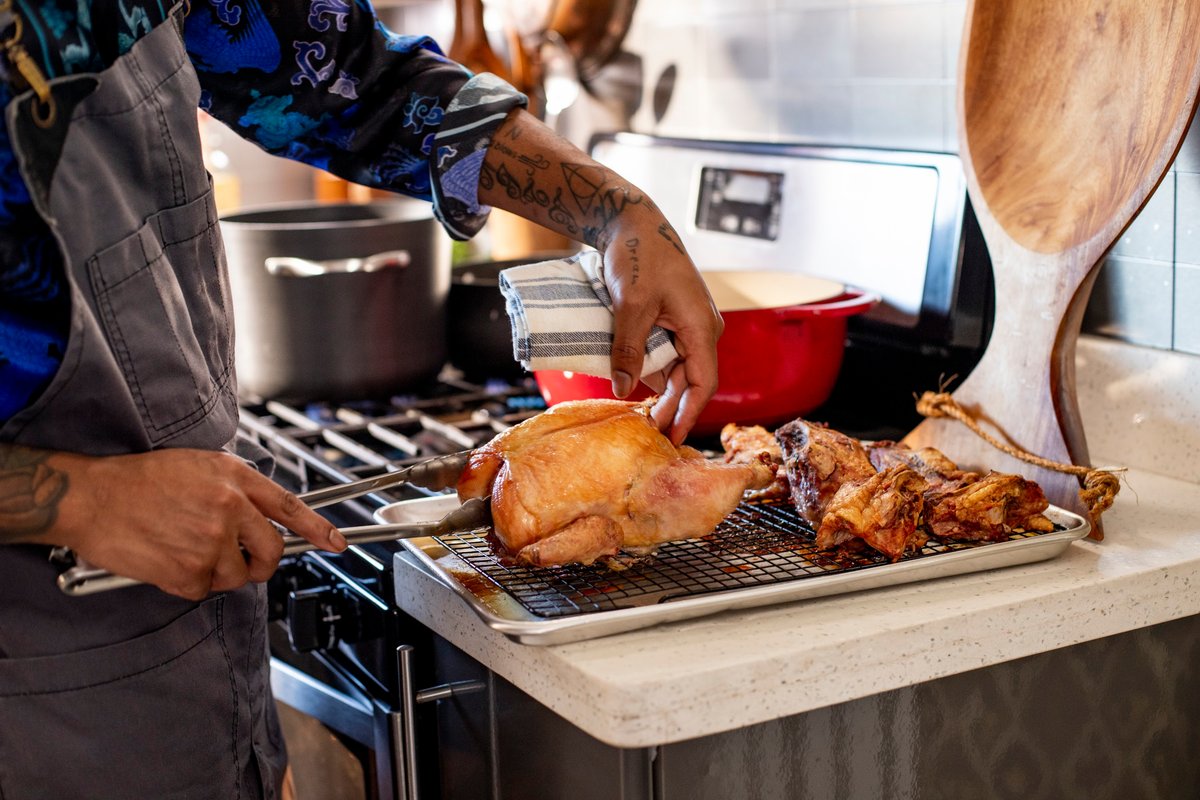
What is the safe temperature for chicken?
USDA lists a single minimum for all poultry: 165°F (73.9°C), as measured with a food thermometer before the food comes off the heat. That covers breasts, thighs, legs, wings, a whole bird, ground chicken, giblets and stuffing, and USDA gives the same 165°F for leftovers and casseroles. It is a minimum, not a ceiling: USDA adds that cooks may choose a higher temperature for personal preference, which is where dark meat comes in later in this guide. Poultry also has no rest time attached to it. For steaks, chops and roasts of beef, pork, veal and lamb, USDA lists 145°F with a 3-minute rest.
What is the chicken temperature chart by cut?
Use this as a checklist at the stove. The temperature in every line is the USDA minimum. The times are USDA’s approximate roasting times at 350°F (177°C) for unstuffed chicken, useful for planning dinner and nothing more: the thermometer decides when chicken is done, never the clock.
| Cut | Safe minimum (USDA) | Approximate time at 350°F (177°C), unstuffed | Note |
|---|---|---|---|
| Bone-in breast (6 to 8 oz, about 170 to 225 g) | 165°F / 74°C | Roughly 30 to 40 minutes | |
| Boneless breast (about 4 oz, 115 g) | 165°F / 74°C | Roughly 20 to 30 minutes | |
| Thigh or leg (4 to 8 oz, about 115 to 225 g) | 165°F / 74°C is the safe minimum | Roughly 40 to 50 minutes | America’s Test Kitchen says dark meat is tender at about 175°F / 79°C or higher |
| Drumstick (about 4 oz, 115 g) | 165°F / 74°C | Roughly 35 to 45 minutes | Same dark meat note as thighs |
| Wing (2 to 3 oz, about 55 to 85 g) | 165°F / 74°C | Roughly 30 to 40 minutes | |
| Whole chicken, unstuffed (3 to 4 lb, about 1.4 to 1.8 kg) | 165°F / 74°C in the innermost part of the thigh and wing and the thickest part of the breast | Roughly 1 1/4 to 1 1/2 hours | If you stuff it, USDA adds 15 to 30 minutes and says the center of the stuffing must reach 165°F too |
| Ground chicken | 165°F / 74°C | No time given here | Go by the thermometer |
| Leftovers and casseroles | Reheat to 165°F / 74°C |
On leftovers, USDA says to refrigerate within 2 hours (1 hour if it is above 90°F), to divide big batches into shallow containers so they cool fast, and that leftovers keep 3 to 4 days in the refrigerator.
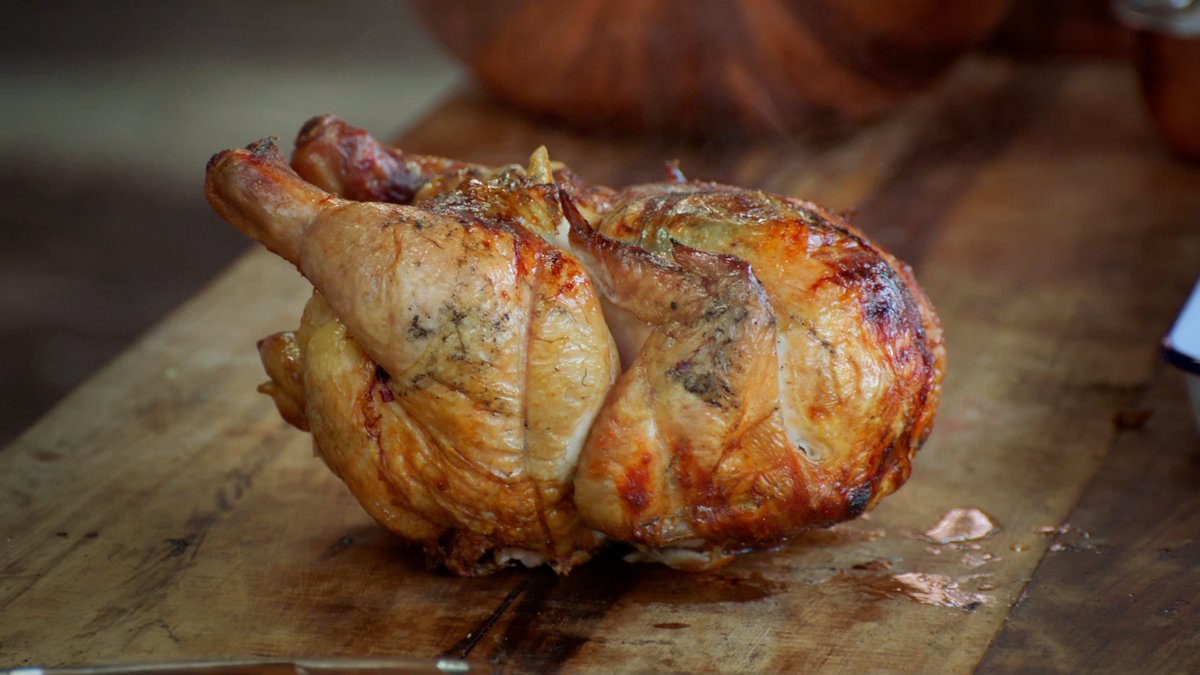
Where do you put the thermometer, and how do you know it is accurate?
A thermometer is the only reliable test, so placement matters. For a whole bird, USDA says to check the innermost part of the thigh and wing and the thickest part of the breast. For parts, push the probe into the thickest area and keep it off the bone. USDA says it can go in sideways if that is easier. For thin cuts such as a boneless breast, USDA prefers a fast thermocouple or thermistor thermometer. With an instant-read dial, insert the probe through the side of the meat so the whole sensing area (usually 2 to 3 inches) sits in the center. For thighs, America’s Test Kitchen adds a margin: stay at least 1/4 inch from the bone, because touching it gives a false reading. Check near the end of the estimated time, not at the start, so you do not overcook. To test the thermometer itself, USDA’s ice-water method is to fill a glass with finely crushed ice, add clean tap water, stir, and hold the stem at least 2 inches deep for at least 30 seconds without touching the sides or bottom. It should read 32°F (0°C). Many dial models have a calibration nut under the dial, so check the package.
Is pink chicken safe, and can you trust the color?
Not by color alone, in either direction. USDA says safely cooked poultry can vary from white to pink to tan, and that all the meat, including any that stays pink, is safe once every part reaches at least 165°F on a food thermometer. It explains that pink can come from chemical changes during cooking: gases in the oven react with hemoglobin in the meat, and young birds show it most. Chicken grilled or smoked outdoors can stay pink well above 165°F, and the darkening around bones in young chickens is a looks issue, not a safety one. The reverse also holds. USDA says appearance and color are not reliable indicators of safety or doneness, so chicken that looks cooked through can still be under 165°F. Probe it.
Why do thighs and drumsticks taste better above 165°F?
165°F makes chicken safe, but not necessarily tender. America’s Test Kitchen says dark meat carries a lot of connective tissue that dissolves into gelatin as it cooks, so unlike breasts, thighs and drumsticks get more tender the longer they cook. It rates 175°F (about 79°C) as very good and 190 to 195°F (about 88 to 91°C) as even better, and warns that past 210°F (99°C) the meat turns stringy. Treat those as America’s Test Kitchen’s own texture advice, not a safety rule. USDA’s only line is 165°F, with anything higher left to personal preference. So the practical split is simple: stop a breast around 165°F, and let a thigh or drumstick run higher if you want it falling off the bone.
How does Kwame Onwuachi braise chicken legs until they are done?
Kwame Onwuachi shows what a long, moist cook looks like in his Brown Stew Chicken and Fried Plantain lesson, and the Brown Stew Chicken recipe is written for chicken leg quarters. The legs sit in a marinade for 24 to 48 hours (our guide to how to marinate chicken covers the method, and USDA says chicken can be marinated in the refrigerator for up to 2 days). Then he scrapes the marinade off and sears the legs in a Dutch oven over high heat until deep golden brown on both sides. In the lesson he says the sear is only to brown the chicken, not cook it through. USDA warns never to brown or partially cook chicken to finish later, and here the legs do not wait: they go back into the pot with the sautéed vegetables, ketchup and chicken stock. They simmer over medium-low heat for 45 minutes, then with the lid off for another 30 minutes until the sauce is reduced and glazes the chicken. Neither the lesson nor the recipe card gives a thermometer reading. Kwame’s finish line is chicken tender enough to be almost falling off the bone, so we will not guess what the pot reaches. Probe the thickest part of a leg, away from the bone, confirm at least 165°F, and watch for the 175°F that America’s Test Kitchen ties to tender dark meat. Next time you braise, take a reading when you lift the lid at 45 minutes and again at the end, and write both down: your own pot will teach you more than any chart.

Kwame Onwuachi started peeling shrimp and stirring roux at 5 years old in his mother’s catering kitchen in the Bronx. The James Beard Award-winning chef has received many accolades since then, including FOOD & WINE’S Best New Chef, Esquire Magazine’s 2019 Chef of the Year, 30 Under 30 honoree by both Forbes and Zagat, and has appeared on Bravo’s Top Chef as both a contestant and judge. In his class, Onwuachi embraces the richness of Afro-Caribbean culture and cuisine, and teaches home cooks how to cook his favorite Jamaican recipes.